
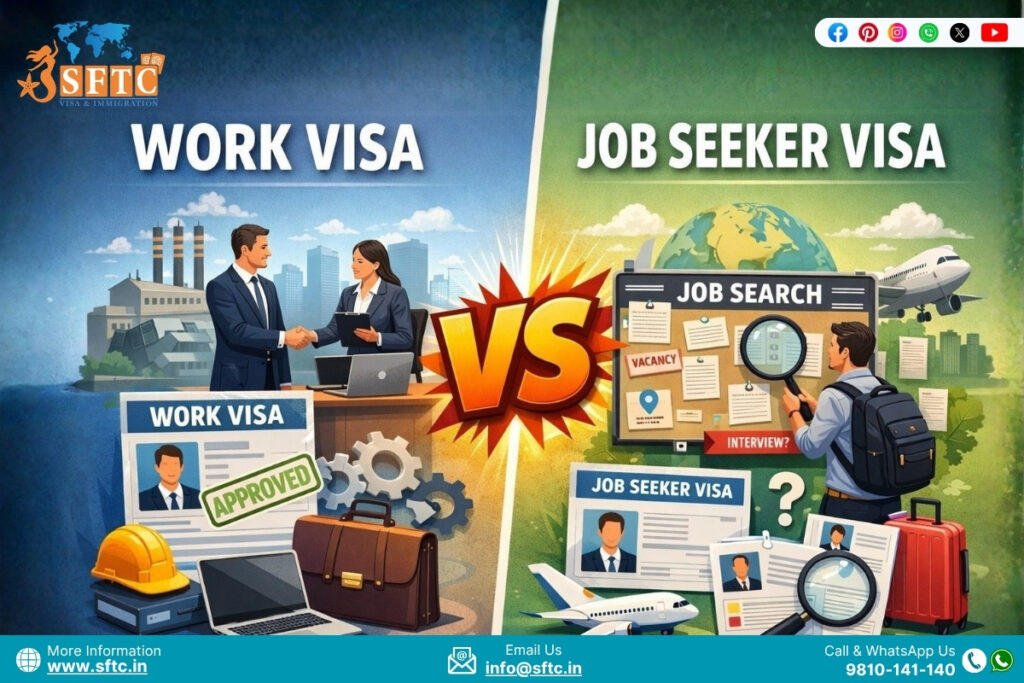
Work Visa vs Job Seeker Visa – Differences Explained
In today’s interconnected world, many professionals are seeking opportunities to work abroad. Whether you’re exploring job opportunities or already have an offer, understanding visa options is crucial. Two common visa types for international job seekers are the Work Visa and the Job Seeker Visa.
At SFTC (Starfish Travel Corporation), we assist individuals in making informed decisions about which visa is right for them. In this blog, we will explain the differences between the Work Visa and the Job Seeker Visa, helping you understand which one best suits your needs.
What is a Work Visa?
A work visa permits foreign nationals to travel to a country for purposes of employment. It’s usually issued after an applicant has been offered an offer of employment by a business in the country. The visa is usually linked to the company and allows the worker to reside and work within that country throughout the period of their contract.
Important Points About Work Visa:
- Employment Requirement: You require an official job offer prior to applying for an employment visa.
- Duration: Usually for the duration of your contract with you, with a possibility for extension.
- Attached to Employer: A visa is typically tied to an employer specifically, and a change in employment could require approval or a new visa.
What is a Job Seeker Visa?
A job seeker visa permits the applicant to travel to the country in search of employment. Contrary to a work visa, you don’t require a job offer prior to applying for this type of visa. If you are able to secure an employment offer on a job seeker visa, you are able to transition into a work visa.
- No Job Offer Needed: No job offer is required.
- Temporary Visas: Usually only valid for a brief period (3-12 months) to allow you time to search for employment.
- Flexibility: Once you have an offer, you can transform your job seeker’s visa into a working visa.
- Eligibility: Generally, it requires evidence of relevant qualifications as well as work experience.
Work Visa vs Job Seeker Visa—Key Differences
Let’s now compare the two types of visas one by one to assist you in making an informed choice.
Feature | Work Visa | Job Seeker Visa |
Purpose | If you already have an offer of employment. | For those looking for an employment opportunity in another country. |
Job Offer Requirement | Yes, you must get an offer prior to submitting your application. | You don’t have to get an offer to apply. |
Duration | It is tied to the duration of time. | Temporary, typically for 3-12 months. |
Flexibility | Limits in flexibility, restricted to one employer. | The flexibility allows for a job search with many employers. |
Conversion | It is not necessary; you are employed already. | You can change into the Work Visa once you secure employment. |
Eligibility | The requirements for this are to meet the requirements of the company. | It is required to show proof of the qualifications and experience. |
Advantages of a Work Visa:
- Immediate Employment on Arrival: You are legally able to begin working immediately upon arrival in the country you are staying in.
- Long-term stay visa: These are typically valid for the duration of the term of employment, but with a chance of being renewed. This provides you with the possibility of staying for a longer period.
- Access to Benefits for Employees: Certain work visas allow employees to take advantage of benefits like healthcare and social security contributions and various other benefits for employees, depending on the country of residence.
Disadvantages of a Work Visa:
- Flexible but limited: A work visa is typically linked to a specific employer. That means it is not possible to switch jobs without requesting an additional visa or undergoing further approval procedures.
- Job Offer Mandatory: You need to have a job offer that has been confirmed before you are able to apply for a visa. This is a problem for those who are still seeking employment.
- Renewal based on the Employer: The renewal of your visa is usually dependent on the continued existence of your employment with the same company, and any changes in your employment status could impact the status of your visa.
Advantages of a Job Seeker Visa:
- No Job Offer Needed: It is possible to get this visa even though you don’t have a formal job offer, which gives you the chance to research jobs in the country.
- Flexible searching for jobs: The Flexible Search for Jobs Seeker Visa provides the freedom to look for jobs across a range of industries and businesses. This flexibility will aid you in finding the ideal job match.
- Time to settle: A visa is usually granted for several weeks (usually between 3 and 12 months), which gives you enough time to find work with no pressure to find an immediate job.
- Steps to Transition: Once you have found the right job, you can effortlessly move from the Job Seeker Visa to a Work Visa, allowing you to remain and work legally within this country for a long time.
Disadvantages of a Job Seeker Visa:
- Temporary Visa: This visa is usually granted for a limited time, and you need to secure employment prior to the time your visa expires. If you do not get a job within that period, you could be forced to leave the country.
- No immediate employment: Although the visa permits the applicant to seek employment, it doesn’t grant the ability to begin working until the applicant receives an offer from a prospective employer and then transitions into a work visa.
- Uncertainty: There’s no guarantee that you’ll get a job during the validity of your visa, which could be confusing if you are unable to get a job in time.
- The time limit for finding employment is limited. Based on the laws of the country, there may be an established time frame to find an employment opportunity, and after that, your visa expires, and you’ll have to quit.
Conclusion
In the end, both the Work Visa and the Job Seeker Visa provide distinct advantages, dependent on your present employment status and future career goals.
- If you’ve already gotten an offer to work and are eager to begin working overseas, the work visa is the simplest alternative. It gives you job security and permanent benefits for your employment, but it will bind you to a particular employer.
- However, if you are searching for work and you want the freedom to seek jobs and not be restricted by the time you are there, the Job Seeker Visa offers an excellent chance. This type of visa allows you time to locate the perfect job without requiring an offer of employment before your search, and after you have been employed, you are able to transition to a work permit.
Ultimately, your choice will depend on your personal circumstances—whether you already have a job lined up or are in the process of finding one. We at SFTC (Starfish Travel Corporation) are experts in helping people to navigate the maze of international visas. If you require assistance with finding a job, submitting for a visa, or transferring between different visa types, we’re ready to assist you throughout the process.
FAQs
1. How can you tell the difference between a Work Visa and a Job Seeker Visa?
The Work Visa is issued when you are offered a job, which allows the worker to legally work within the country. On the other hand, the Job Seeker Visa lets you visit a country for employment. Here at SFTC (Starfish Travel Corporation), we can help you pick the best visa depending on your specific career goals and assist you through the procedure.
2. Do I need to have a job offer to be eligible for a Job Seeker Visa?
The answer is no, a job seeker visa does not need a job offer. You are able to visit the country to look for job opportunities. SFTC (Starfish Travel Corporation) will guide you through the process and offer assistance in finding employment opportunities once you’re in the country.
3. How can I find the right visa for me?
The decision to choose between a Work Visa and a Job Seeker Visa is dependent on your job status and the policies of the country’s visa authorities. SFTC (Starfish Travel Corporation) provides expert advice to help you decide on the most appropriate visa option depending on your specific situation.
4. What is the best way for SFTC (Starfish Travel Corporation) to help with the process of applying for visas?
At SFTC (Starfish Travel Corporation), we offer a wide range of support, from choosing the correct visa type to assistance with documentation and the application submission process. Our staff will make sure that the visa process goes smoothly and punctually and increases the likelihood of being approved.
Disclaimer: All the details mentioned in the article are subject to change without any prior notice. Always cross-verify the visa & immigration requirements and policies with the concerned consulates before filing the application.