
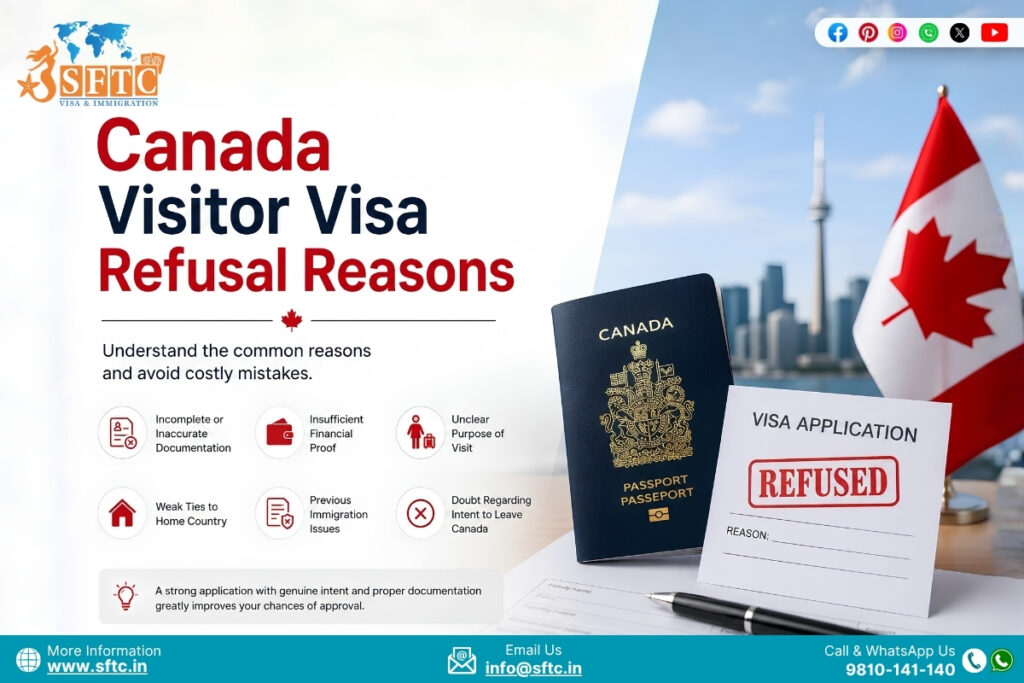
Canada Visitor Visa Refusal Reasons
Are you planning to travel to the stunning landscapes of Banff, or perhaps visit your family members in Toronto, or experience the lively city life in Vancouver? Many thousands of travelers are eligible to apply for a Temporary Resident Visa (TRV) to enter Canada every year. But, as per the latest Immigration, Refugees, and Citizenship Canada (IRCC) figures, the rate of refusal for visitor visas has been increasing to nearly 50% over the last couple of months.
A letter of refusal could be a massive disappointment, particularly when it comes to the desire to travel to another country and then return. The trick to converting a “No” into a “Yes” is to understand what caused the mistake. Visa officers aren’t able to deny applications on hand. They adhere to strict legal requirements set out in the Immigration and Refugee Protection Act (IRPA).
This comprehensive guide will allow you to understand the most frequent Canada visa denial reasons, giving practical suggestions and examples to help beginners and veterans in creating an effective application.
1. Lack of Strong Ties to the Home Country
The primary legal reason for the legal basis for a Canadian visa rejection can be found in subsection 179(b) within the IRPR in which it states it is the case that an official from immigration isn’t certain that you will leave Canada after the expiration of your period of legal residence. In order to be able to overturn this, you must provide compelling reasons for bringing the applicant back into your country of origin.
If you’re unable to prove that your life or family obligations and commitments to the long term depend primarily on the status of your country of birth, IRCC will view you as a potential risk of staying for too long.
- Employer profile that is unstable: newly employed, on temporary contracts or lacking documentation of the validity of a leave authorization issued by your employer.
- Minimum assets: If you don’t own any businesses or properties, and the long-term investment of financial assets in the country of your origin.
- A lack of dependents: Being young, single, and without family members (spouse, children, or even parents older than you) who heavily depend on your help.
2. Insufficient Proof of Funds or Financial Instability
In order to obtain a temporary stay, it is necessary to show the immigration official you could afford the round-trip flight and accommodation, food, and other emergency expenses, without needing to be incriminated or relying on Canadian government funding. sector.
The mere fact of having money in your bank account isn’t enough. Visa representatives scrutinize the facts of your wealth. They look for consistency and steady income streams as well as transparency of transactions for at least six months.
- “Fund parking” or sudden deposits: Injecting an enormous, unknown lump of cash into your bank account prior to the submission of an application is an obvious alarm.
- Low relative income: Having huge savings accounts yet having an income report for a month with very little earnings is a clear contradiction.
- Lack of secondary assets: relying only on savings in cash and not having other financial backups like income tax returns (ITRs) or mutual funds or fixed deposits.
3. Unclear Purpose of Visit or Vague Itinerary
An organized, coherent story must accompany your application. If a person cannot explain in detail the goals they’re planning to achieve on a vacation for a long time, IRCC officers naturally assume that the sole purpose of an application was to give an excuse to hide an ulterior motive.
A simple statement such as “I plan to visit Canada to travel” is not going to pass the initial examination. Your application needs to be a thorough daily schedule that’s in line with your budgeting capability and travel plan.
- Uncustomized or uncompleted Statements of Usage (SOP), the submission of an unspecific template copied from forums on the internet.
- Insane Travel Windows Planned for a vacation of four weeks, but your employer will only give you five days of vacation.
- Family visits that are not substantiated by the reason you claim to be visiting a distant relative but you do not possess a formal letter of invitation, proof of Canadian citizenship, or other documentation that establishes your relationship with them.
4. Weak or Non-Existent International Travel History
Everyone starts with an empty passport, which is a challenge for you to prove your worth as a tourist who abides by the foreign visa laws.
Visa officers consider having a good record of traveling to other countries with strict regulations (like Australia, the UK, the USA, and Schengen zone) as a huge positive point. If you’ve never left your country of origin and you suddenly decide to take a costly journey across the globe to Canada, you need a compelling reason.
- Application with a New Passport: The applicant has no history of short-term international departures or timely return.
- Inability to highlight past compliance: Forgetting to scan and also include expired or valid visas, as well as entry/exit stamps from previous travels.
5. Inconsistent Documentation and Minor Application Mistakes
Even if you’re a genuine tourist with lots of money, an unprofessional appearance and inconsistencies on your forms could undermine your application.
Every element on the IMM forms and portal entries on your digital and physical identification certificates should be in perfect alignment. Inconsistencies in the information could give an immediate impression of dishonesty or a lack of care.
- Disparities in employment: You may include one name for your job on the visa application form; however, you must provide a letter from your employer that says something completely different.
- Incomplete Visa Requests: not declaring the refusal of a visa in any country, including visa refusals from the US, UK, or Australia. Canada is an active member of the Five Eyes that have biometrics and pipelines. Refusing to acknowledge the past refusal is deemed to be fraud and could result in an automatic suspension for five years from Canada.
Canada Visitor Visa Refusal vs Approval Comparison
Factor | Visa Approval | Visa Refusal |
Financial Stability | Strong bank balance | Weak or suspicious funds |
Travel History | Good travel record | No travel history |
Purpose of Visit | Clear itinerary | Unclear plans |
Home Country Ties | Strong job/business ties | Weak ties |
Documentation | Complete & genuine | Incomplete or incorrect |
Return Intent | Clearly explained | Doubtful immigration intent |
How to Overcome a Canada Visa Rejection
If you’ve previously been denied a request, don’t be pushed into submitting the same documents. Use this guideline to determine how to appeal for a refund of your request:
- Demand GCMS Notes: You are able to get notes from the Government General Case Management System (GCMS). These internal documents offer specific, line-by-line notes provided by the immigration official that go beyond the typical checkboxes on the refusal letter.
- Make a customized introduction letter: Directly address the question you raised in your letter of refusal. If the officer has mentioned financials, you must present a logical description of your financial situation.
- Check your financial records: If you received an unexpected surprise windfall or gift from an individual in your family, provide an unambiguous, notarized statement of the gift, along with the history of your bank account of the person who gave it to you.
- Certified Translations Make sure that all documents local to business and property registrations, as well as locally issued bank accounts, have been translated into English as well as French with the help of authorized translators.
Conclusion
Understanding the myriad of Canada visa refusal causes may be overwhelming. But a rejection is not always the end of the line. The majority of visa refusals don’t originate from a lack of real intent but from the way in which that intention is packaged, structured, and presented to an immigration agent. Through systematically addressing the core concerns like proof that you are financially stable, clearly written travel plans, and an unquestionable connection to your country of origin, you can transform your profile when applying for a visa.
We at SFTC (Starfish Travel Corporation) are experts in transforming complicated documents that pertain to international travel, as well as recruitment rules, into simple, efficient strategies. It doesn’t matter if you’re a novice applicant attempting to understand IRCC guidelines or an experienced professional seeking to rectify an error in your application that was made in the past; meticulously preparing is the best method to ensure that you’re successful. Don’t make a list of a general nature; make your travel plans difficult. Use the techniques in this guide to clear any doubts and buy internal case notes if needed before submitting any visa application with confidence.
FAQs
1. Can I apply for a visa right away after a Canada visa refusal?
2. What is the right balance to get a Canadian tourist visa?
3. Do copies of a Statement of Purpose (SOP) cause refusal of an entry visa?
Disclaimer: All the details mentioned in the article are subject to change without any prior notice. Always cross-verify the visa & immigration requirements and policies with the concerned consulates before filing the application.