
By Starfish Corporation: Yashdeep Malik & Shivani Sharma
Date: 07-Oct-2026
What Is Proof of Funds for a Visa Application?
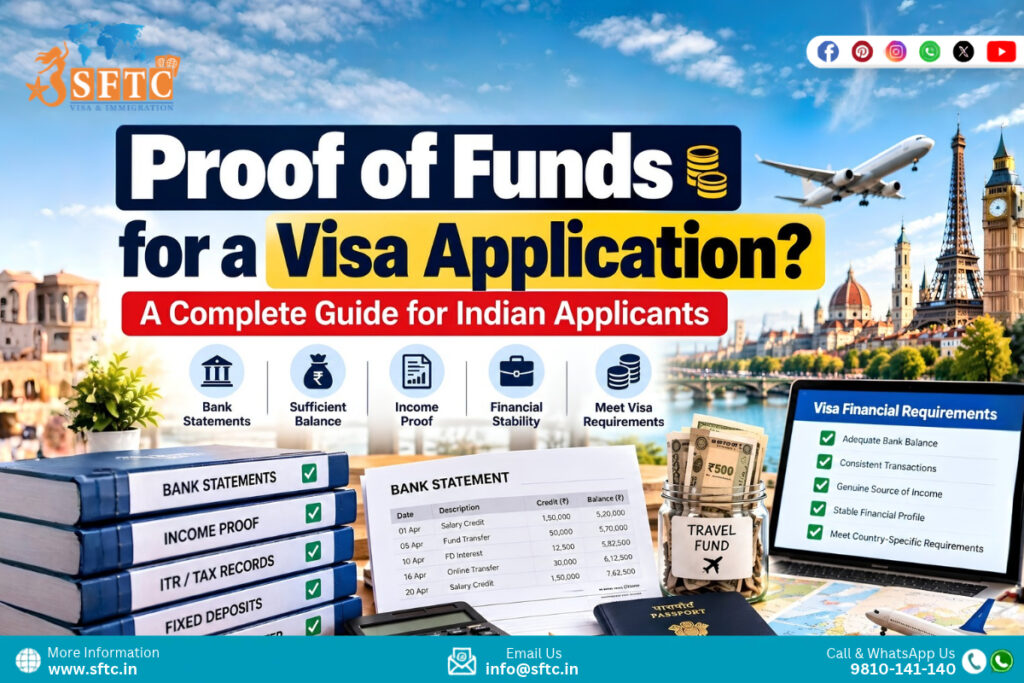
To get a visa for tourism, higher education, work, or business purposes, you must convince immigration officials that you are a genuine visitor who can afford the trip. Of all the documents you submit for your visa application, your proof of funds (POF) is one of the most closely examined.
Any small mistake in your documentation or an unexplained transaction can lead to an instant refusal of your visa, regardless of how strong your travel itinerary or academic profile is. It is important to know what proof of funds means and what documents consular officers require. A structured financial portfolio is the key to a smooth visa process.
What is proof of funds for a visa application?
Proof of Funds (POF) is the financial documentation you need to submit with your visa application to demonstrate that you have sufficient accessible funds to meet all your travel, accommodation, living, and tuition costs whilst in a foreign country and for your return travel to your home country.
Proof of funds is a requirement from immigration departments around the world, including the US Department of State and UK Visas and Immigration (UKVI), European Schengen embassies, Immigration, Refugees and Citizenship Canada (IRCC) and Australia’s Department of Home Affairs, for two purposes:
- Financial Independence: You will not be suffering financial hardship or be a drain on public funds or on overseas healthcare.
- Prevention of Illegal Employment: You will not seek unauthorised or illegal employment when you are in non-work or visitor status and will have legitimate resources.
Acceptable Documents for Proof of Funds
Some assets or bank documents do not prove funds. Consular officers work in liquidity — money that is available immediately, without delay or penalty.
1. Bank Statements (3-6 months)
The main way to prove funds is to present official bank statements from the last three to six months. Consular officers look for closing balances, regular salary or income deposits, and how long the account has been open. Statements must be stamped with a bank stamp and signed by a branch official.
2. Fixed Deposits / Term Deposits (FDs)
Many embassies (including in Schengen countries, Canada, and Australia) accept certificates of deposit. But the deposit has to be in liquid form. Allow early withdrawal, if required. You will also need a certificate from the bank stating the amount of the deposit and conditions of withdraw.
3. Income Tax Returns (ITR) and Form 16
Income tax returns for the last two or three years are helpful in showing financial stability and a steady income. It means your bank balance is what it should be for your income. We also accept Form 16, as it is proof of salary and tax deduction.
4. Sponsor Affidavits and Documents from the Sponsor
If someone else is paying for your trip or studies, you need to provide:
- A notarised Affidavit of Support explaining your relationship to the sponsor and their willingness to pay the costs.
- Six months’ recent bank statements of the sponsor.
- Sponsor’s tax returns.
- Documents of identification of the sponsor.
- Proof of your relationship, like a marriage certificate or a birth certificate.
5. Educational Loan Section Letters
Student visa applications are accepted with loan approval letters from recognised banks or financial institutions. The sanction letter should mention the loan amount, the disbursal of funds, and the applicant’s details.
6. Property appraisals and investment certificates (secondary evidence)
Documents like mutual fund units, stock portfolio summaries, government bonds, or property valuations done by a chartered accountant can strengthen your profile. They show that you have money and connections back home. They cannot replace real liquid cash needed for travel or study expenses.
Proof of Funds Requirements by Destination
Visa | Typical Statement Duration | Primary Acceptable Proof | Key Financial Focus |
|---|---|---|---|
Schengen Area (Europe) | 3 to 6 Months | Bank statements, ITR (3 years), Sponsor Affidavit | Daily allowance per country guidelines + accommodation proof |
United Kingdom (UKVI) | 28-day Holding Period | Bank statements, loan sanction letters | Minimum 28 consecutive days holding threshold before application |
Canada (IRCC) | 4 to 6 Months | Bank statements, GIC (for students), FD certificates | Proof of 1st year tuition + minimum CAD 20,635 living expenses |
United States (US F-1/B1/B2) | 3 to 6 Months | Bank statements, Form I-20, Sponsor I-134 | Liquid funds for 1st-year tuition/living + secondary asset net worth |
Australia | 3 to 6 Months | Bank statements, education loans, government support | Proof of living costs (AUD 29,710/year) + tuition fees |
Common Proof of Funds Mistakes That Lead to Visa Refusal
- Unexplained Lump-Sum Deposits (“Fund Parking”): Taking money to increase a bank balance just before applying is easy to find out and is seen as lying.
- Submitting Non-Assets Only: Giving property values or real estate details without enough money in the bank leads to being turned down because there is no cash available.
- Missing Bank Verification Elements: Papers that are not stamped or printed online without the bank logo, branch information, or manager’s signature are usually not accepted.
- Mismatch Between Income and Savings: If your income is low but your account suddenly has a lot of money without proof from tax officials, they will not believe the account is real.
- Incomplete Statement Period: Giving 2 months of statements when the embassy asks for 6 months causes the documents to be rejected right away.
Conclusion
Securing your visa requires more than filling out forms—it demands a clean, credible, and fully documented financial presentation. By maintaining balances, preparing authentic bank documentation, avoiding last-minute transfers, and understanding specific country guidelines, you significantly increase your approval chances.
Planning a holiday, higher education abroad, or a global career shift? SFTC (Starfish Travel Corporation) provides visa guidance, documentation reviews, and tailored itinerary management to ensure your application meets every embassy standard smoothly. Reach out to our travel specialists today to start your journey with confidence!
FAQs
1. What is the minimum bank balance needed when applying for a visa?
2. Can I use a relative's bank statement to support my visa application?
3. Why do embassies get worried about cash deposits that happen suddenly?
Disclaimer: All the details mentioned in the article are subject to change without any prior notice. Always cross-verify the visa & immigration requirements and policies with the concerned consulates before filing the application.