By Starfish Corporation: Yashdeep Malik & Shivani Sharma
Date: 20-Oct-2026
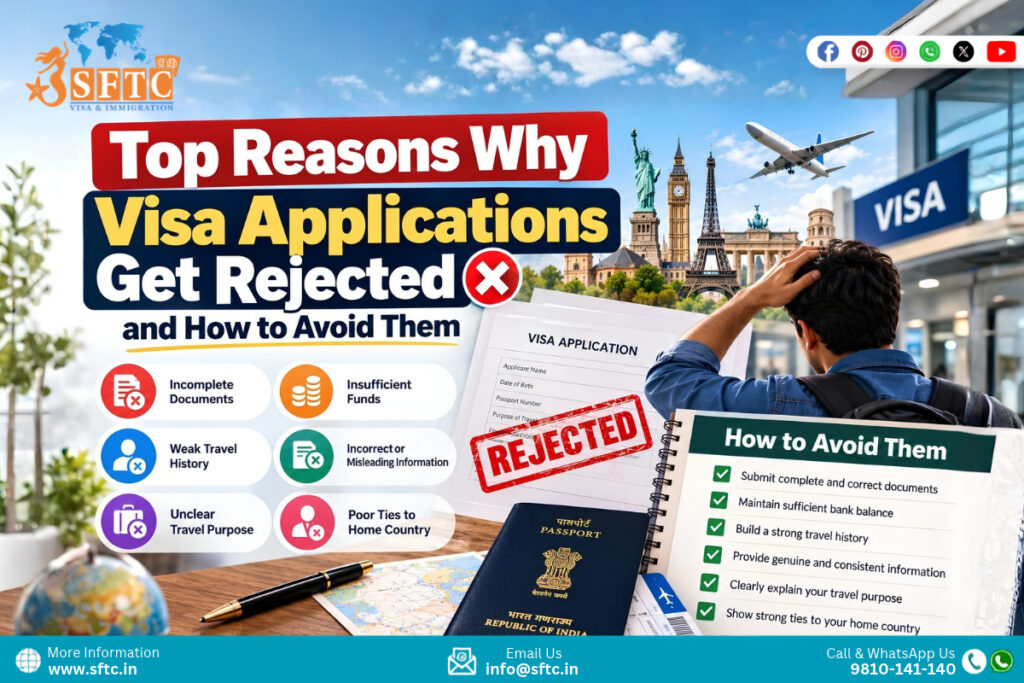
Top Reasons Why Visa Applications Get Rejected and How to Avoid Them
The Starfish team says consular officers review hundreds, if not thousands, of dossiers each day. After examining denials, they found that most are caused by avoidable errors, incomplete documentation, unproven financial information, or the applicants’ inability to clearly explain the purpose of the trip.
Knowing why visas are rejected and how to build a winning application is the key to turning rejections into approvals quickly.
In this guide, we explore the common reasons for visa refusals in popular countries and give you practical steps to safeguard your application. Get ready. Follow the steps below to troubleshoot the 3 Pillars of Visa Success. Before we discuss the triggers for rejection, it is important to understand how the immigration officer evaluates an application. The decision to grant a Schengen visitor visa, a US B1/B2, a Canadian TRV, or an Australian work permit is based on three core pillars:
- Purpose of Visit: Is the purpose of travel clear and genuine, and is it in line with the type of visa you are applying for and your personal profile?
- Proof of Financial Capacity: Can you show you have enough legitimate and liquid funds to pay your travel, accommodation, and living expenses without unlawful employment?
- Strong ties to your home country: Do you have any professional, financial, or personal ties that will guarantee your return before your visa expires?
Top 7 Most Common Reasons Why a Visa Application is Rejected
1. Insufficient or questionable financial information
Be sure of this: financial checks are critical for visa evaluation. Consular officers don’t just look at your final account balance – they look at your transaction history, funding stability, and source of income, along with overall declarations of fundamental assets.
- Fund Parking or Sudden Cash Flows: Depositing a large, unexplained figure into a bank account right before applying for something immediately draws red flags. Consulates view this as an unauthorised temporary loan to defraud immigration.
- Irregular Flow of Income: If you maintain a high account balance without any conclusive evidence of regular salaries, business revenues, or verified assets, it may give rise to suspicion about the legitimacy of your wealth.
- Insufficient Cash Reserves: Not having enough liquid cash to pay for round-trip airfare, accommodation, daily expenses, and emergency buffers often results in denial.
2. Not enough evidence of strong ties to your home country
Under major immigration frameworks—such as Section 214(b) of the US Immigration and Nationality Act or Subsection 179(b) of Canada’s IRPR—applicants are presumed to be intending immigrants unless they prove otherwise.
- Freelancers, newly employed individuals, or short-term contract workers with no long-term job security.
- Applicants who do not have any physical assets, property, or established business entities in their country of residence.
- If you don’t possess strong proof, such as a letter from your employer confirming your leave, certified property deeds, or documents proving family dependency, consulates will view you as a risk of overstaying.
3. Incomplete, Mismatching or Fraudulent Documentation
Human error is still the top reason for visa refusals. Filing half-filled forms, no supporting documents, or inconsistent information across the documents will immediately raise a red flag.
- Data Mismatch: If there is a mismatch between the travel dates mentioned in your cover letter, hotel bookings, flight itinerary, and employer’s No Objection Certificate (NOC), your profile may be marked unreliable.
- Unverified Employers: Immigration authorities are cracking down on job offers, employer registration numbers, and tax filings. Listings with invalid contact details or non-existent company addresses are rejected immediately.
- Fake Documents: It is illegal to submit fake bank statements, hotel vouchers or certificates. Consulates possess complicated webs of cross-verification. Fraudulent paperwork is rejected immediately and leads to legal action and multi-year or permanent bans across alliance countries.
4. Generic Cover Letters & Unclear Purpose of Travel
The tenuous travel goal did not convince the officers. Adding “I want to visit Europe for tourism” on a cover letter or Statement of Purpose (SOP) is not enough.
Also, using generic SOP templates copied from the internet can affect your credibility. Consular officers can easily spot unoriginal templates that do not explain how your trip logi
5. Concealing previous visa refusals
Trying to conceal a prior visa denial from any country is a major mistake. Global intelligence-sharing systems like the Five Eyes network (USA, UK, Canada, Australia, New Zealand) and the Schengen Visa Information System (VIS) allow for the smooth exchange of biometric and immigration data.
Failing to disclose a previous refusal, even if it happened many years ago, constitutes misrepresentation or fraud, and results in an automatic visa denial and long-term entry bans.
6. Applying at the Wrong Consulate (or “Visa Shopping”)
If you are travelling to multiple destinations (e.g., the Schengen Area), you cannot simply choose the consulate with the shortest appointment wait time or the lowest processing fee. This practice is called “visa shopping” and is heavily penalised. Make sure to keep yourself safe from such disasters.
According to the international consular rules:
- You have to make an application to the embassy of the country where you will spend most of the time.
- If you spend the same number of days in more than one member state, you have to apply to the embassy of your first point of entry.
Applying to the wrong consulate results in administrative refusal or denial of entry at border control
7. Bad Interview Performance
For visa types that require an in-person consular interview (such as US visitor visas or some student and work visas), your verbal delivery is just as important as your written paperwork.
Delivering heavily rehearsed/memorised answers, showing extreme nervousness, failing to maintain eye contact, or contradicting details in your written DS-160/application form raises serious doubts about your true intentions.
Visa Refusal vs. Visa Approval: Key Differences
Evaluation Factor | High-Risk Application (Prone to Refusal) | Audit-Ready Application (Positioned for Approval) |
|---|---|---|
Financial Track Record | Sudden lump-sum cash deposits right before filing. | 3–6 months of steady income with documented transaction history. |
Home Country Ties | No property, unverified job, or family dependencies declared. | Formal employer leave approval, property deeds, or family commitments. |
Purpose & Itinerary | Copy-pasted generic SOP with unverified hotel holds. | Customised daily itinerary matching verified accommodation & flight holds. |
Travel History | Undeclared prior visa rejections or blank travel profile. | Fully declared immigration history with proof of past visa compliance. |
Document Accuracy | Typographical errors, missing seals, or conflicting travel dates. | Fully verified, cross-matched, and certified translated documentation. |
Proven Strategies to Prevent Visa Rejections
1. The “Golden Rule” and the “Buffer Rule” of finance.
To provide a credible financial profile:
- The Golden Rule: Keep bank statements for 3 to 6 months with active and consistent salary credits or business revenues. If you receive an unexpected bonus, windfall or return from the sale of property, you will need to provide notarised legal documentation showing exactly where the funds came from.
- The Buffer Rule: Keep at least 2 to 3 times the amount of your anticipated travel expenses in available cash on hand. For example, you are planning a 14-day trip out of the country, and it will cost you $3,000. Have cash reserves of $6,000 to $9,000 to show financial stability.
2. Record what makes you want to come back
Provide tangible evidence that you have to return home after your visit:
- Employment: Attach an official NOC on company letterhead with designation, salary, approved dates of leave and expected date of return to duty.
- Business Owners: Business registration certificates, latest tax returns (ITRs) and company bank statements.
- Assets & Family: Certified copies of land title deeds, lease agreements or birth/marriage certificates of dependent family members living in your home country.
2. Record what makes you want to come back
Provide tangible evidence that you have to return home after your visit:
- Employment: Attach an official NOC on company letterhead with designation, salary, approved dates of leave and expected date of return to duty.
- Business Owners: Business registration certificates, latest tax returns (ITRs) and company bank statements.
- Assets & Family: Certified copies of land title deeds, lease agreements, or birth/marriage certificates of dependent family members living in your home country.
3. Draft a Personalised Cover Letter and SOP
Write a cover letter that is unique to you and your background. Clearly state:
- Travel dates, job, and full name.
- The specific purpose of your trip.
- Who’s footing the bill, and how are costs being split?
- A detailed, realistic day-by-day itinerary including city moves and accommodations.
4. Do a Comprehensive Data and Document Check
Do a Comprehensive Data and Document Check
- Before you submit your file or book your biometric appointments:
- Your passport should be valid for at least six months beyond your intended date of departure and have at least 2–3 blank pages.
- Check that your name, date of birth, and passport number are consistent across all civil documents, diplomas, employment letters, and application portals.
- Ensure that your bank statements are stamped and signed by your branch authority.
Proven Strategies to Prevent Visa Rejections
Applying late creates unnecessary stress and increases the chance of losing important documents. Here are general lead time guidelines:
Visa Type | Ideal Application Timeline | Key Focus Area |
|---|---|---|
Tourist / Visitor Visa | 2 to 3 months before travel date | Flight schedules, hotel holds, and financial liquid proof. |
Student Visa | 4 to 6 months before the intake semester | Academic alignment, SOP, and tuition fee funding history. |
Work / Employment Visa | 3 to 5 months before the employment start date | Employer verification, contract details, qualification matching. |
Permanent Residency (PR) | As early as possible upon meeting eligibility | Point scores, skill assessments, and official police clearances. |
Conclusion
A visa application is not a lottery. It is a systematic test of lucidity, transparency, and documented credibility. Your chances of a positive outcome are greatly improved by avoiding common pitfalls such as sudden deposits of funds, generic cover letters for the internet, travel itineraries which are not verified, and refusal histories which are not disclosed.
It can be daunting to navigate the shifting sands of consular policies, financial verification requirements, and document formatting. Your file will be audited by a professional to ensure it is correct before you submit it.
SFTC (Starfish Travel Corporation) visa experts will review your profile in detail, verify your financial and employment documents, draft a strong Statement of Purpose, and turn potential refusal points into easier approvals for the traveller. Whether you are a first-time applicant or want to re-apply after a previous rejection, contact SFTC today and prepare an audit-ready visa application with complete peace of mind.