By Starfish Corporation: Yashdeep Malik & Shivani Sharma
Date: 25-Nov-2026
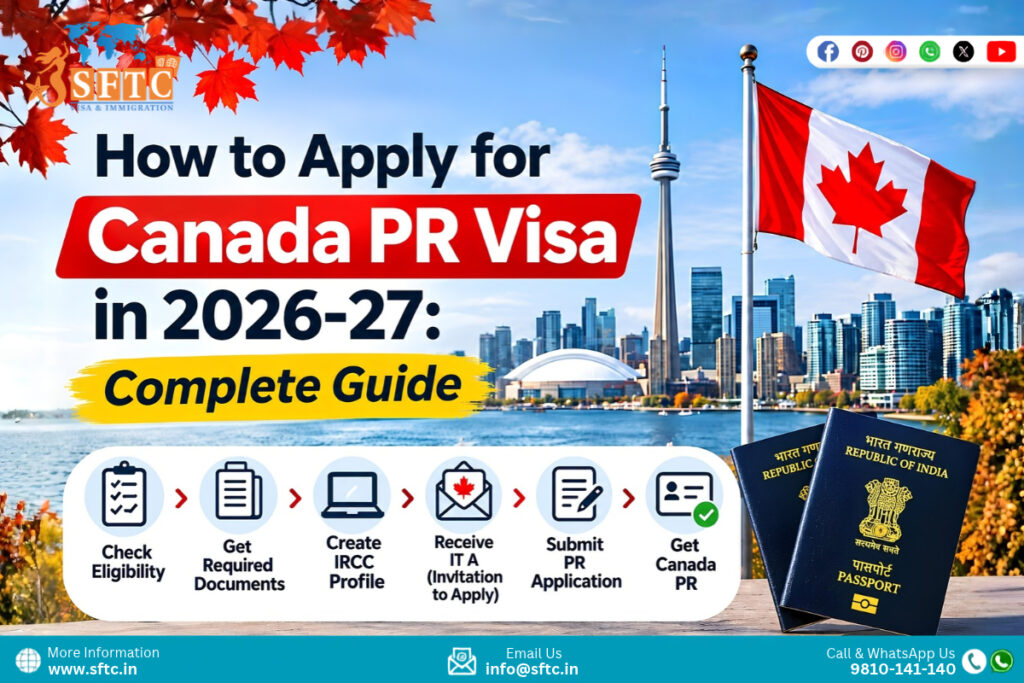
How to Apply for Canada PR Visa in 2026-27: Complete Guide
Canada remains a preferred destination for skilled workers, international graduates, families, and individuals seeking better career opportunities and long-term stability. But to become a Permanent Resident (PR) of Canada, you need to plan well, meet some eligibility conditions, and follow the right immigration process.
If you plan to immigrate to Canada permanently, start by understanding the immigration pathways available to you. Several pathways exist, including Express Entry, Provincial Nominee Programmes (PNP), family sponsorship, and regional immigration programmes.
It can seem complicated, especially when you need to understand language requirements, educational assessments, work experience, settlement funds, and immigration fees.
This guide details how to apply for a Canada PR visa in 2026, covering the latest immigration updates, eligibility requirements, application process, estimated expenses, and practical advice to enhance your chances of getting an Invitation to Apply (ITA). Regardless of whether you are applying from India, the UAE, the Philippines, or any other country, this guide will assist you in understanding the process and preparing a realistic immigration plan.
What Is Canada Permanent Residency (PR)?
Canadian permanent residency is an immigration status that allows eligible foreign nationals to live, work, and study in Canada without needing a temporary work or study permit. A permanent resident is not a Canadian citizen but enjoys several rights and benefits.
Canadian permanent residency is an immigration status that allows eligible foreign nationals to live, work, and study in Canada without needing a temporary work or study permit.
A permanent resident is not a Canadian citizen but enjoys several rights and benefits.
- The right to live anywhere in Canada, subject to applicable immigration programme conditions.
- The ability to work for most Canadian employers.
- Access to eligible publicly funded healthcare, subject to provincial or territorial rules.
- The opportunity to study at Canadian educational institutions.
- Protection under Canadian law and the Canadian Charter of Rights and Freedoms.
- The possibility of applying for Canadian citizenship after meeting the required conditions.
Permanent residents must also meet their residency obligation. Generally, they must be physically present in Canada for at least 730 days in every five years, subject to specific exceptions.
Canadian PR is different from a visitor visa, study permit, or work permit. These temporary immigration documents do not automatically provide permanent resident status.
Why Apply for Canada PR in 2026?
Canada offers several opportunities for people who want to establish a long-term future abroad. Some of the main reasons applicants consider Canadian permanent residency include:
1. Employment Opportunities
Canada has employment opportunities across healthcare, technology, engineering, construction, education, transportation, and other industries. Skilled professionals may qualify for economic immigration programmes depending on their experience and other credentials.
2. Family Security
Permanent residents can live in Canada with eligible accompanying family members. They may also qualify to sponsor certain relatives under applicable family sponsorship rules.
3. Education Opportunities
Permanent residents can access many educational opportunities and may qualify for domestic tuition rates, depending on the institution and applicable provincial rules.
4. Healthcare Access
Permanent residents may qualify for provincial or territorial public healthcare coverage. Eligibility and waiting periods depend on the province or territory.
5. Long-Term Settlement
Canadian PR can provide a pathway towards citizenship once the applicant meets the applicable residency, language, and other citizenship requirements.
What Are the Different Ways to Apply for Canada PR in 2026?
Canada offers several permanent immigration pathways. Choosing the right programme depends on your education, occupation, work experience, language ability, family connections, and preferred destination.
1. Express Entry System
Express Entry is one of Canada’s main immigration management systems for skilled workers. It manages applications for three federal economic immigration programmes:
- Federal Skilled Worker Program (FSWP).
- Canadian Experience Class (CEC).
- Federal Skilled Trades Program (FSTP).
Applicants create an online profile and enter the Express Entry pool if they meet the requirements of an eligible programme.
The system calculates a Comprehensive Ranking System (CRS) score. Candidates are ranked against other eligible applicants and may receive an ITA through an applicable invitation round.
Who should consider Express Entry?
- Skilled professionals with foreign work experience.
- Individuals with eligible Canadian work experience.
- Qualified tradespeople.
- Applicants with strong English or French language results.
- Candidates with recognised educational qualifications.
2. Federal Skilled Worker Program (FSWP)
The Federal Skilled Worker Program is designed for individuals with qualifying skilled work experience inside or outside Canada. It suits professionals who have established careers in their home countries and want to immigrate to Canada.
- At least one year of continuous, paid skilled work experience in the relevant primary occupation within the previous ten years.
- Work experience in an eligible NOC TEER 0, 1, 2 or 3 occupation.
- A minimum Canadian Language Benchmark (CLB) 7 in all four language abilities.
- At least a secondary school education.
- An Educational Credential Assessment (ECA) for foreign education when required.
- At least 67 points under the programme’s separate selection factors.
- Proof of settlement funds, unless an exemption applies.
Applicants should understand that the FSWP’s 67-point eligibility grid and the Express Entry CRS ranking system are two different assessments.
3. Canadian Experience Class (CEC)
The Canadian Experience Class is intended for skilled workers who have gained qualifying work experience in Canada. It can be particularly useful for international graduates and foreign workers who have already established professional experience in the Canadian labour market.
- At least one year of qualifying Canadian work experience within the previous three years.
- Work experience in eligible TEER 0, 1, 2, or 3 occupations.
- CLB 7 for TEER 0 and TEER 1 occupations.
- CLB 5 for TEER 2 and TEER 3 occupations.
Unlike the Federal Skilled Worker Program, the CEC does not require a minimum education level or proof of settlement funds. However, applicants must still satisfy the programme’s other eligibility and admissibility requirements.
4. Federal Skilled Trades Program (FSTP)
The Federal Skilled Trades Program is designed for qualified workers in eligible trade occupations.
- Electrical trades.
- Plumbing.
- Carpentry.
- Welding.
- Construction.
- Industrial mechanics.
- Certain manufacturing and processing occupations.
Applicants generally need:
- At least two years of qualifying skilled trade work experience within the previous five years.
- The required language proficiency: CLB 5 for speaking and listening and CLB 4 for reading and writing.
- A valid full-time job offer for at least one year or a certificate of qualification issued by a Canadian provincial, territorial or federal authority.
Education is not a mandatory minimum requirement under this programme.
5. Provincial Nominee Program (PNP)
The Provincial Nominee Program allows participating Canadian provinces and territories to nominate individuals who meet their regional immigration and labour market requirements.
Each province has its own streams, eligibility conditions, and selection priorities.
- Ontario Immigrant Nominee Program (OINP).
- British Columbia Provincial Nominee Program (BC PNP).
- Alberta Advantage Immigration Program (AAIP).
- Manitoba Provincial Nominee Program (MPNP).
- Saskatchewan Immigrant Nominee Program (SINP).
- Nova Scotia Nominee Program.
- New Brunswick Provincial Nominee Program.
Some PNP streams are connected to Express Entry, while others operate through separate application processes. An Express Entry-linked provincial nomination can provide 600 additional CRS points under the applicable CRS rules, significantly improving a candidate’s ranking. However, receiving a provincial nomination does not mean that federal permanent residency is automatically approved. Applicants must still complete the required federal assessment.
6. Family Sponsorship
Family sponsorship is another way to obtain Canadian permanent residency. Canadian citizens and permanent residents may be able to sponsor eligible family members, depending on the relationship and applicable immigration rules.
Common sponsorship categories include:
- Spouse or common-law partner.
- Dependent children.
- Parents and grandparents, subject to programme requirements and intake availability.
Certain other eligible relatives in limited circumstances.
The sponsor must meet the relevant eligibility and financial requirements. Family sponsorship is different from Express Entry because applicants generally qualify through an eligible family relationship rather than a competitive CRS ranking.
Canada PR Eligibility Requirements in 2026
Category | Selection Focus |
French-Language Proficiency | Strong French language ability |
Healthcare and Social Services | Eligible healthcare and social service occupations |
STEM | Selected science, technology, engineering and mathematics occupations |
Trade Occupations | Eligible skilled trades |
Education | Selected teaching and education occupations |
Transport | Eligible transport occupations |
Physicians | Physicians with Canadian work experience |
Senior Managers | Senior managers with Canadian work experience |
Researchers | Researchers with Canadian work experience |
Skilled Military Recruits | Eligible skilled military recruits |
Canada PR Visa Documents Checklist for 2026
Preparing your documents early can help reduce delays and avoid unnecessary mistakes. The exact checklist depends on your immigration programme and personal circumstances. The following table covers commonly required documents for skilled worker applications.
Document | Purpose |
Valid Passport | Identity and travel information |
Language Test Results | English or French proficiency |
ECA Report | Assessment of foreign education, when required |
Educational Certificates | Academic qualifications |
Employment Reference Letters | Verification of work experience |
Salary Slips or Employment Records | Supporting employment evidence |
Proof of Funds | Financial settlement evidence, when required |
Police Clearance Certificates | Criminal admissibility assessment |
Medical Examination Results | Medical admissibility |
Marriage Certificate | Verification of marital status, if applicable |
Birth Certificates | Family relationship verification, if applicable |
Provincial Nomination Certificate | Evidence of provincial nomination, if applicable |
Digital Photographs | Identity documentation, as instructed |
Common Mistakes to Avoid When Applying for Canada PR
Even eligible candidates can face difficulties because of avoidable mistakes.
Common Mistake | How to Avoid It |
Selecting an Incorrect NOC Code | Match job duties with official NOC descriptions. |
Using an Expired Language Test | Check test validity before applying. |
Providing Incorrect Work Experience | Submit accurate employer documentation. |
Ignoring ECA Requirements | Check whether an assessment is necessary. |
Miscalculating Settlement Funds | Follow the latest IRCC requirements. |
Missing Application Deadlines | Track the 60-day ITA deadline. |
Providing Inconsistent Information | Cross-check every application form. |
Ignoring Provincial Programmes | Research other eligible immigration pathways. |
Trusting Guaranteed PR Promises | Verify information through official government sources. |
Conclusion
Applying for Canadian permanent residency requires more than completing an online application. You need to select the right immigration programme, understand its eligibility requirements, prepare accurate documents, and develop a realistic strategy.
Express Entry remains an important option for skilled workers, while Provincial Nominee Programs, family sponsorship, and regional immigration pathways provide additional opportunities for eligible applicants. The most effective approach is to evaluate your education, work experience, language proficiency, occupation, and financial position before choosing an immigration route.
Immigration requirements, application fees, and selection priorities can change. Therefore, always verify the latest information through official Immigration, Refugees and Citizenship Canada (IRCC) resources before making important decisions.
If you need help with travel planning, immigration-related travel arrangements, or preparing for your move, SFTC (Starfish Travel Corporation) can be a useful point of contact for travel support. Consult an appropriately authorised Canadian immigration professional for personalised immigration advice.
FAQs
1. How can I apply for a Canada PR visa in 2026–27?
2. What are the eligibility requirements for Canada PR in 2026?
3. What is the minimum IELTS score required for Canada PR in 2026–27?
Disclaimer: All the details mentioned in the article are subject to change without any prior notice. Always cross-verify the visa & immigration requirements and policies with the concerned consulates before filing the application.