
By Starfish Corporation: Yashdeep Malik & Shivani Sharma
Date: 13-June-2026
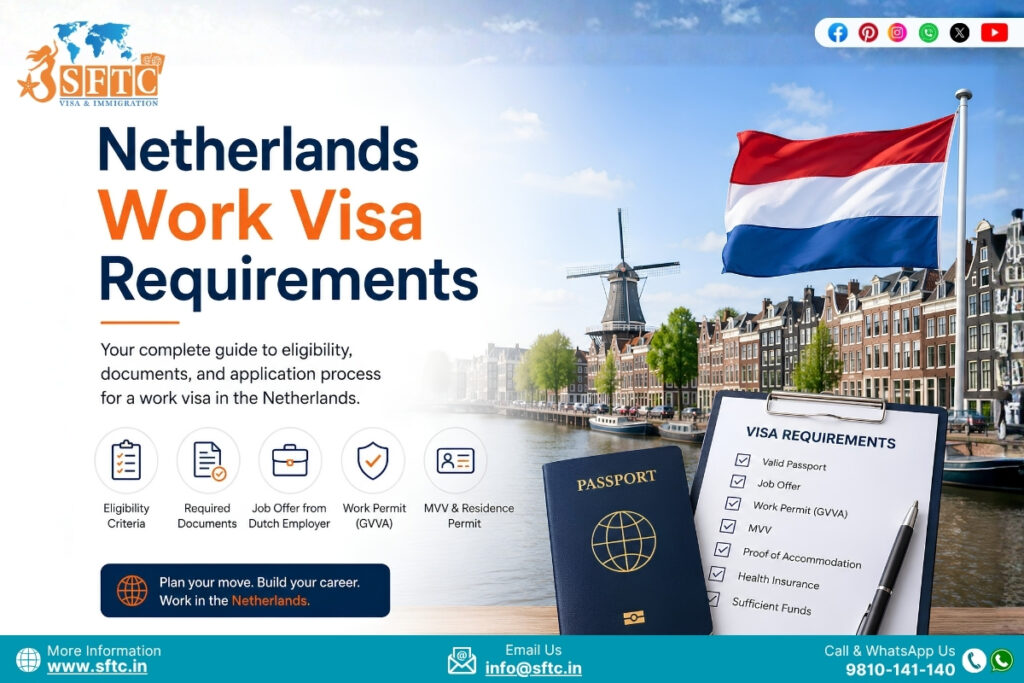
Netherlands Work Visa Requirements
Moving to Europe to further your career is a dream of many professionals, and the Netherlands is consistently ranked among the top destinations. It is renowned for its excellent lifestyle and great standard of living, as well as flourishing industries in the fields of business and technology. The Netherlands is extremely welcoming to international talent. But before you can set off to enjoy the cycling journey through the canals of Amsterdam, you must overcome the critical hurdle of securing your permission to be employed.
It can be daunting, particularly with the recent changes made by the Dutch Immigration and Naturalization Service (IND). If you’re looking to make a successful career in the country of windmills and tulips, knowing the Netherlands’ requirements for work visas is the first and most crucial step.
This thorough, fact-based guide provides everything you must be aware of regarding Dutch work permit requirements as well as the latest wage thresholds, document checklists, and the process for applying to ensure that your international move is smooth.
1. Do You Need a Work Visa for the Netherlands?
Before examining the intricate regulations, let’s identify the people who need an entry visa. The requirements for immigration in the Netherlands are largely contingent on your nationality.
- European Union/European Economic Area and Swiss Citizens: If you have a passport issued by a European Union (EU) or European Economic Area (EEA) country or Switzerland, you’re lucky. You are entitled to freely move around. You are able to live, search for work, and take jobs within the Netherlands without the need for a visa or permit to work.
- Foreign Non-EU/EEA Citizens (Third-Country Citizens of Third Countries): If you’re seeking to work outside the EU, such as in India or in the USA, Canada, South Africa, or the United Arab Emirates, you need to obtain a valid work visa and a residence permit before you are legally able to begin working for an employer in the Netherlands. Dutch employer.
2. Key Types of Netherlands Work Visas
The Dutch government doesn’t offer one “one-size-fits-all” work visa. Instead, it categorizes work permits according to your field of work, qualification level, and the amount you earn. Understanding these distinct paths can help you determine your Dutch work permit.
- Highly Skilled Migrant Visa (Kennismigrant)
This is the most popular and simplified method for professionals from abroad who are relocating to the Netherlands to work. It is specially designed for IT professionals, specialists, engineers, technicians, and corporate managers. The main benefit? It doesn’t need a local labor market test, and the processing time is incredibly quick.
- The Single Permit (GVVA)
The GVVA includes the work authorization (TWV) and the residence permit in a single document. It is generally used in the case of regular work when the employee doesn’t reach the salary requirements that are part of the high-skilled migrant program. To qualify for this option, your employer must demonstrate they couldn’t find a suitable candidate in the EU/EEA region for at least five weeks.
- European Blue Card
An EU-wide program aimed at skilled professionals. Although it is similar to the highly skilled migrant visa, it is based on the completion of higher education (a minimum 3-year bachelor’s-level degree) and provides more convenient permanent mobility to the other European Union member states.
- Orientation Year Visa (Zoekjaar)
If you recently graduated from a top-ranked international institution or a Dutch higher education institution, this visa allows you a year of residence in the Netherlands and searching for a highly skilled occupation without immediate sponsorship from your employer.
3. Core Netherlands Work Visa Requirements in 2026
To be eligible for a Dutch work visa, you and your employer must meet the strict requirements that are set by the IND.
The Mandatory Job Offer
It is not possible to apply for an ordinary Netherlands work permit by yourself without having a corporate backup. An official, legally binding employment contract or an official employment offer from an authorized business situated within the Netherlands is a must.
IND-Recognized Sponsor Status
To be eligible for the Highly Skilled Migrant visa and EU Blue Card pathways, the prospective employer must be recognized as an “IND-Recognized Sponsor” (erkend referent). This means that the business has been vetted through Dutch immigration authorities as a stable, financially stable, and reliable company that has been licensed to speed-track foreign talent.
Market Conformity Check
The Dutch government closely monitors foreign hiring to prevent wage-exploitative practices. The IND ensures that your salary is in line with the market rate that is for Dutch residents or local workers who have the same job descriptions and experience levels within the particular sector.
4. The 2026 Salary Thresholds for Dutch Work Permits
For the vast majority of high-skilled employees, Savisa approval is contingent heavily on your compensation plan. The IND adjusts the income criteria each year based on the national wage index.
The salary limits for March (excluding the standard eight% Dutch vacation allowance) will depend on your age and the visa process:
Visa Category / Applicant Age | 2026 Gross Monthly Salary Threshold |
Highly Skilled Migrant (Aged 30 or older) | €5,942 |
Highly Skilled Migrant (Aged under 30) | €4,357 |
Reduced Salary Criterion (Orientation Year / Grads) | €3,122 |
European Blue Card (Standard) | €5,942 |
European Blue Card (Recent Graduates) | €4,754 |
Crucial Compliance Rule: The IND specifies that only contractually guaranteed, fixed-gross-cash transactions count toward this threshold. Variable performance bonuses, speculation allowances, and overtime estimates are not counted toward the monthly minimum requirement.
The salary limits for March (excluding the standard eight% Dutch vacation allowance) will depend on your age and the visa process:
5. Mandatory Document Checklist for Applicants
Ensuring you have the proper documentation is the longest phase of the Netherlands’ work visa process. You must make sure that every official document issued by the EU is properly translated to English, Dutch, German, or French and legally valid by means of a stempel, apostille, or legalization stamp from the embassy.
- Valid Passport: The passport you are using must include at minimum two blank pages and be in good condition for no less than six months beyond your scheduled arrival date.
- Employer’s Contract Signed Copy of the official Dutch employment contract that clearly outlines the title of your job as well as working hours and the amount you earn.
- Educational Certificates: Copy of your degree or diplomas that may require evaluation at the time of evaluation by Nuffic (the Dutch organization for internationalization of education).
- Antecedent Certification: A completed integrity certificate stating that you don’t have any criminal convictions and are not a risk to Dutch public security.
- Birth and Wedding Certificates: Moving with your spouse or children, the apostilled certificates are required to establish the family’s ties.
6. The Step-by-Step Netherlands Work Visa Process
The application process itself is extremely collaborative. Your employer will be the primary driver, and you will be the primary source of documentation.
- Get a job and sign your contract for a job: Pass your interview, and get an employment contract in writing from an IND-approved sponsor that complies with the 2026 threshold for salary regulations.
- Employer submits the digital application: The employer collects your personal documents and then submits the application for a combination of the VV (provisional entrance visa) as well as your residence permit through the online IND portal for business. They pay the EUR 423 processing fee to the government.
- The MVV should be collected at the Dutch Embassy: After the IND accepts your request (typically around 2 to 4 weeks with IND-approved sponsors), you must make an appointment with the nearest Dutch Embassy or VFS Global center in your country of residence to provide biometrics and to stamp the entry stamp (MVV) on your passport.
- Travel and Register in the Netherlands: Arrive in the Netherlands. Schedule a city appointment with the local town council (Gemeente) to verify your physical address and get your vital Citizen Service Number (BSN).
- Take the residence card you have: Go to an IND office to collect your residence card, which is biometric in nature and serves as your official ID and work authorization for up to five years.
7. Major Financial Benefit: The 30% Ruling Tax Benefit
The most appealing aspect of moving to the Netherlands for a job is the 30-% rule (30%-regeling). This is a fantastic tax incentive specifically designed for highly skilled workers from abroad who are hired from abroad.
If you satisfy the strict eligibility requirements, the employer can provide up to 30% of your salary completely tax-free for a maximum period of five years. This can significantly boost the amount you earn at home, which helps to offset the initial costs of moving as you search for a home and get settled in your newly created Dutch life.
Conclusion
The process of obtaining a Dutch working visa can be a well-organized and highly efficient process. The entire process becomes quick and easy when you have cleared the first hurdle of receiving an acceptable job offer from an IND-recognized employer that meets the current minimum wage thresholds in 2026. If you start collecting your paperwork in advance, have your personal documents sealed, and work closely with your employer’s HR department, you can drastically decrease the possibility of processing delays or rejection of visas.
The Netherlands continues to actively search for global talent to drive its economy of innovation. If you possess the professional skills, there’s no better time to establish your document strategy and move your profession to the next stage in Europe.
Finding the plethora of documentation and legal translation validation and checks for compliance required in order to relocate to the Netherlands for work can seem extremely daunting for newbies as well as busy professionals. This is precisely the point at which SFTC (Starfish Travel Corporation) is able to help make your relocation process easier. As your reliable international mobility, career, and transitions provider, SFTC specializes in easing the whole Netherlands work visa application process. From determining your Dutch working permit’s eligibility to ensuring that your employment contract matches the official IND standards for market conformity, our team of relocation specialists will ensure that each step of your visa application is perfectly executed. Do not let compliance issues stall your European career goals. Join SFTC now and confidently step into the future of your career within the Netherlands.
If you satisfy the strict eligibility requirements, the employer can provide up to 30% of your salary completely tax-free for a maximum period of five years. This can significantly boost the amount you earn at home, which helps to offset the initial costs of moving as you search for a home and get settled in your newly created Dutch life.
FAQs
1. Do I have to apply for a Netherlands work visa if I don't have a job offer?
2. How long will the Dutch work visa process last?
3. Are my family members able to be a part of my highly skilled immigration visa?
4. Will I have to be fluent in Dutch to be eligible for an employment visa?
Disclaimer: All the details mentioned in the article are subject to change without any prior notice. Always cross-verify the visa & immigration requirements and policies with the concerned consulates before filing the application.