
By Starfish Corporation: Yashdeep Malik & Shivani Sharma
Date: 27-May-2026
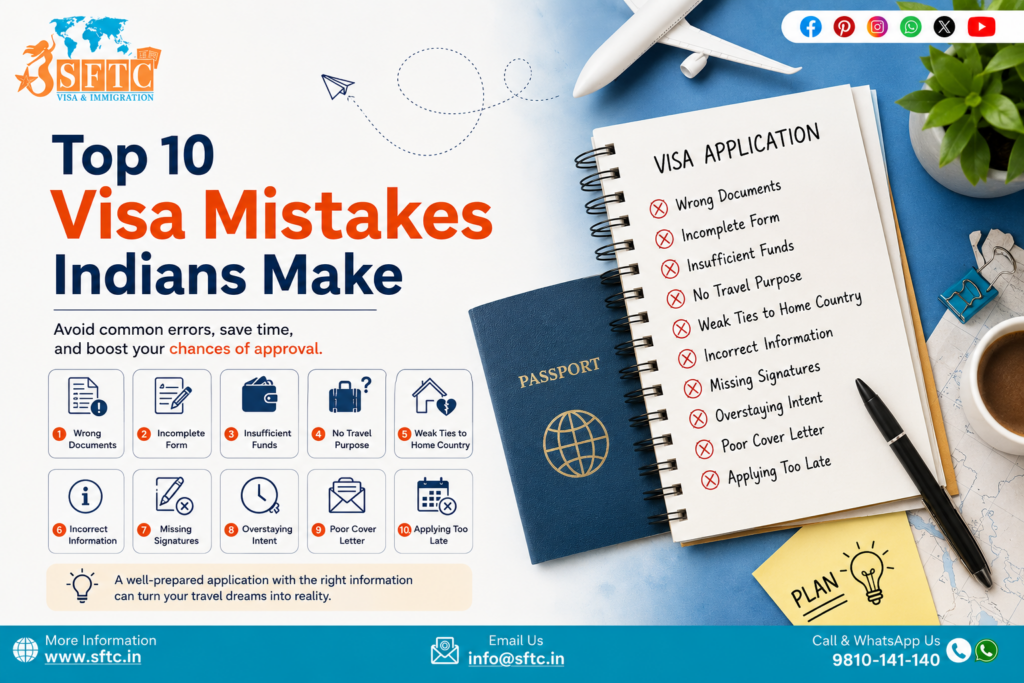
Top 10 Visa Mistakes Indians Make
Planning a trip to another country is a thrilling experience. You’ve decided on the destination, curated your outfits, and selected the most popular local food places. There is one big obstacle behind your ideal vacation. It’s the process of applying for a visa. If you’re an Indian citizen with a passport, the process of navigating visa policies can feel like being in an unexplored minefield.
Even though they have solid itineraries, thousands of Indian travelers are faced with the pain of a rejection notice every year. The most frustrating thing? The majority of refusals do not have anything to do with the possibility of eligibility. Instead, they are caused due to a variety of omissions such as technical mistakes or little-known misconceptions about the criteria consulates use to determine.
To assist you in getting the coveted stamp of approval, we’ve compiled an exhaustive checklist of the most common visa errors Indians make as well as detailed, actionable suggestions for avoiding the mistakes completely.
Understanding the process of obtaining an immigration visa is a crucial step to a successful application. the applications. Visa officers operate on the basis of an underlying sense of common sense: They consider each applicant an immigrant unless the documents show that they aren’t.
Let’s review the most common 10 errors that could cause problems for Indian apps.
1. Presenting Inadequate or Suspicious Financial Proof
The majority of visa refusals are due to poor financial planning. Visa officers want to make sure that you’re able to pay for your trip with no shortage of money or need to do illegal local labour.
Many applicants make the mistake of accumulating a small balance for a long period of time before the sudden, massive cash withdrawal into their accounts just one week prior to the date they are due to submit. To an immigration official, it could be a sign of an unauthorized loan intended to deceive the consulate.
- “The Golden Rule” offers three to six months of bank statements that demonstrate regular income or credit for salary.
- The Buffer Rule: requires you to maintain a reserve sufficient to cover your expected price of the journey multiplied by 2 or 3. If your 14-day European trip costs Rs 2.5 lakhs, your account must have a balance between five and seven lakhs up to the amount of Rs 7 lakhs.
- Effective Tips: When you get an unanticipated reward (like a company or a house sale), you need to provide the legal proof that proves the source of the money.
2. Failing to Prove Strong Ties to India
This is the most significant reason for US visa rejections, 214b, and other major Schengen visa rejections. If you do not prove there is a valid reason for you to leave the country or return to the US, your visa could be denied based on the risk of flying. Recent graduates or freelancers who are unmarried are most likely to be scrutinized.
- Employment Ties: A flimsy salary receipt doesn’t suffice. You must have a valid leave sanction letter from your employer, which includes your name, the duration and amount, and also the exact dates you’ll be required to return to work.
- Families and asset tie-ups indicate the dependent parents of your parents, spouse, parents, children, or spouse: Submit certified property deeds as well as current mortgage statements (EMIs) and current business registration documents to ensure that you can apply in India.
3. Booking Non-Refundable Flights and Hotels Prematurely
If you have to provide a clear plan to transit, purchasing expensive tickets that are non-refundable for flights before the visa decision has been given is a big chance of exposing yourself to risk. The important embassies, such as the Embassy of Ireland and Schengen consulates, specifically state that tickets purchased prior to the announcement of visas are entirely at the discretion of the buyer.
- The best method: Use verifiable flight schedules or hold bookings from reputable travel agents.
- Housing Tracking: Ensure you have confirmations from your hotel that clearly indicate every evening throughout the journey. The absence of a hotel reservation confirmation could signal an inept or untrue travel route.
4. Relying Blindly on General "Visa-Free" and "Visa-on-Arrival" Rules
The value of an Indian passport is increasing, and several countries are now offering an entry visa free of charge to Indian citizens with the passport. A common visa blunder is thinking that “visa-free” is a reference to “visa-free” equaling “zero checks.”
- It’s all about the truth: Going to a visa-free destination means that you won’t need to wait in line at the embassy. When you visit the border counter for immigration, authorities can deny your admission if you do not possess the necessary documents.
- A Must-Have List of Checklists: To be eligible to get visa-free entry, you’ll require an active passport valid for at least six months, a valid travel ticket to return, a thorough daily schedule, and proof that you have cash or a credit card.
5. Technical Mismatches and Typographical Errors
The immigration systems check applications with sophisticated software. An error in clerical procedures could trigger a prompt alert.
- Name and Numéro Discordances Correctly spelling your first and last names and misspelling your maiden name, as well as making mistakes, even just a single number in your passport’s code, could cause delays in processing or rejection.
- Data Synchronization in the event that your cover note states that you’ll travel on June 20th, but the flight tickets show the 22nd of June. The system deems it an untrue and insecure application. Verify every single section against your passport before making your submission.
6. Purchasing Inadequate or Cheap Travel Insurance
In areas such as the Schengen region, travel insurance isn’t a matter of negotiation. A large number of Indian travellers try to cut hundreds of dollars by purchasing local, cheap vacation packages that do not meet the strict requirements of international standards.
- Schengen Details: Your insurance policy must include a minimum amount of protection in the amount of 30 euros (roughly the equivalent of Rs. 27 lakh) in addition to repatriation insurance and be valid in all member states for the entire duration of your stay.
- Solutions: Purchase your insurance only from premium insurance companies that are embassy-approved and print the specific page that lists the amount of coverage as well as the validity of the geographic area.
7. Applying to the Wrong Consulate (Visa Shopping)
In the event of travelling across multiple countries, you shouldn’t apply to the country with the least waiting time or lowest cost. This is known as “visa shopping” and is strictly penalized.
- The dominant Rules Destination: You must apply for an embassy within the country where you’re planning to spend the most time.
- The First-Entry Rules: If you are planning to stay for the same period in two different countries (e.g., five days in France or five days in Italy), then you will need to seek consular assistance within the country you intend to visit for the first time.
8. Submitting Generic, Internet-Copied Cover Letters
The cover letter is your individual voice within the sea of lengthy paperwork. It’s your sole opportunity to impress the immigration agent. By copying the template from the internet and changing names, you don’t have to do anything.
- What you need to compose: Clearly state your name, your job title, the goal of your trip, the person who is funding the trip, and a concise day-by-day overview of your plans for travel. Be honest and real, as well as relevant to your everyday life.
9. Lack of Preparation for Face-to-Face Visa Interviews
In some countries, such as the United States, your paperwork isn’t as crucial as how you appear during those crucial 120 seconds in the consulate’s office.
- Common mistakes: Sounding heavily rehearsed, taking notes straight from your notes and displaying obvious nervousness or fixating while searching for part-time jobs overseas.
- Solutions: Practice mock interviews. Be sure that your answers are confident and clear about your body. Additionally, make sure your explanations correspond to the information you have that is on your application form.
10. Forgetting to Attest Bank Statements or Keep Passports Pristine
A few minor operational errors could lead to immediate rejections. For example, a number of states require bank statements on the internet to be authentically stamped and verified with the manager of your branch at the bank you are using. Furthermore, travelling with a passport with small water damage, damaged edges, or fewer than two empty pages could cause you to be denied at the point of application.
Recommended Timeline
Visa Type | Ideal Application Time |
Tourist Visa | 2–3 months before travel |
Student Visa | 4–6 months before intake |
Work Visa | 3–5 months before joining |
PR Visa | As early as possible |
Conclusion
The process of obtaining a visa for travel abroad isn’t an uneasy or chaotic risk. In the end, the entire process is a test in clarity, sanity, and total transparency. If you can eliminate these most common visa errors Indians make, you can transform the application process into one that is a dependable profile with a low risk that any visa official is comfortable with.
However, keeping up to date with the ever-changing immigration laws, keeping track of financial requirements, or drafting your perfect letter of cover may seem daunting. This is where expert guidance can make everything. We at SFTC (Starfish Travel Corporation) are experts in reducing the complexity of the world of global mobility, international recruiting, and travel documents. Our team of experts ensures that all paperwork is perfect, as well as compliant and optimized to be successful, allowing you to focus on your upcoming trip.
Make sure to use the checklist for your country as the sole guideline, ensure that your financial track is clear and transparent, and allow yourself a safe buffer time prior to your departure. Join forces with SFTC immediately and let us transform the potential reasons for visa refusal into an easy entry point for your travels around the world. Be safe!
FAQs
1. Do I need to reapply immediately following a refusal of a visa?
2. What do I do if my passport is missing an older address, but I am living in another country?
3. How long will the international visa system keep a record of the documents I have previously rejected?
Disclaimer: All the details mentioned in the article are subject to change without any prior notice. Always cross-verify the visa & immigration requirements and policies with the concerned consulates before filing the application.